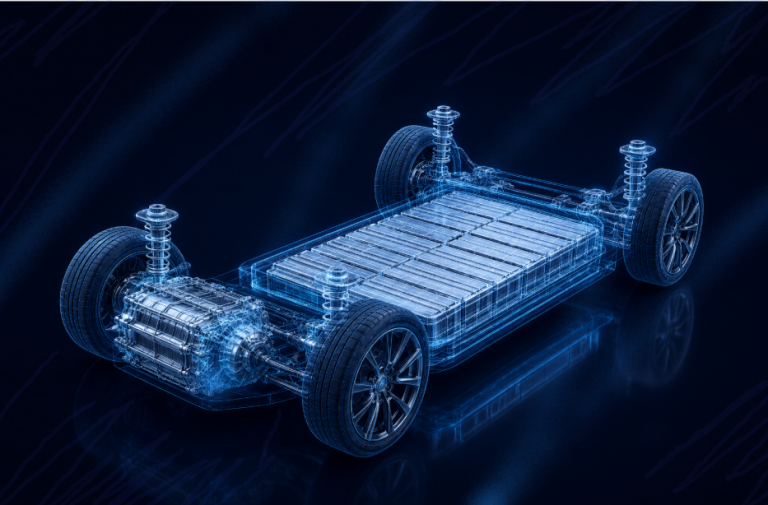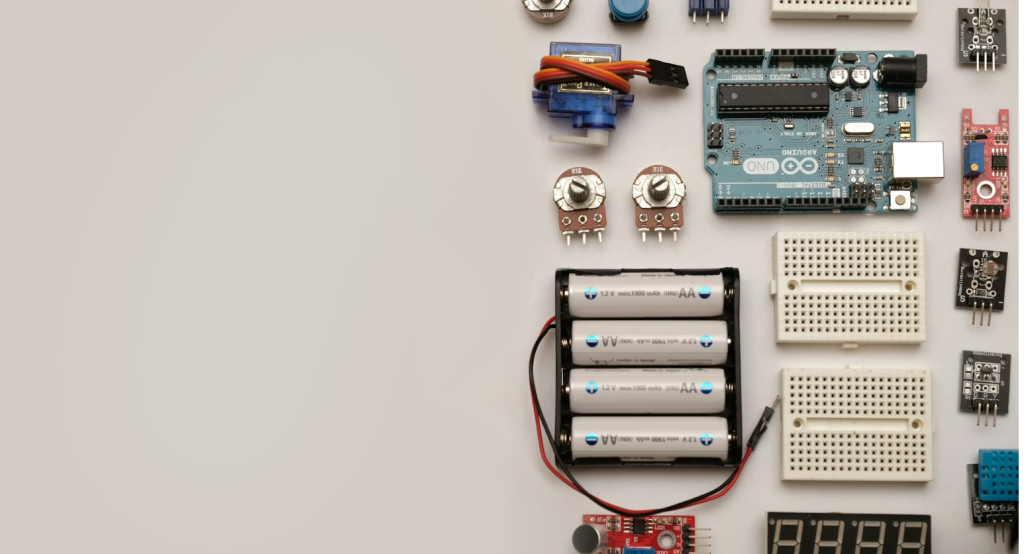
To successfully scale next-generation energy systems—such as solar power, wind, and e-mobility—the key to effective energy management lies in robust, grid-scale battery storage.
But how does a battery actually function, and what exactly happens inside the cell? This technical guide breaks down essential battery mechanics, cell anatomy, and their application in modern energy infrastructure.
Contents
1. Battery Cell Components
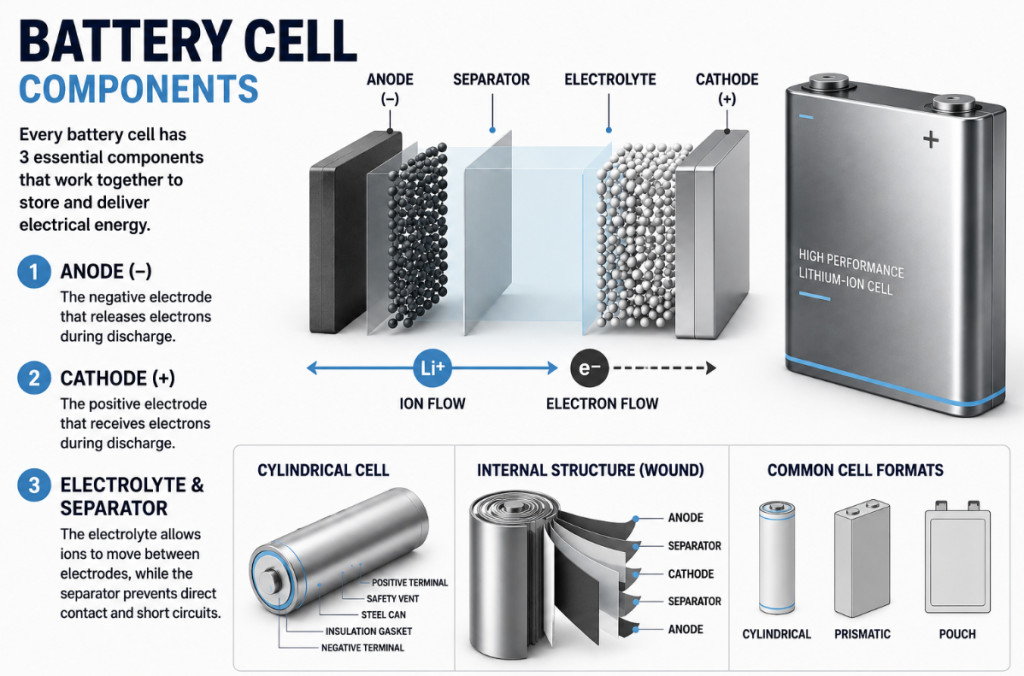
Although battery technologies vary widely in chemistry, size, and application, their fundamental operating principles remain identical. From consumer electronics to electric vehicles (EVs) and grid-scale energy storage systems (ESS), nearly all modern batteries rely on the interaction of three essential internal components: the anode, cathode, and electrolyte system.
These components work together to control the flow of electrons and ions, enabling the battery to store and release electrical energy safely and efficiently.
The Anode (Electron Source)
The anode is the negative electrode. It contains materials with a high concentration of electron-donating atoms, such as lithium, graphite, or zinc. During discharge, the anode undergoes oxidation and releases electrons into the external circuit.
The Cathode (Electron Receiver)
The cathode is the positive electrode. It is composed of advanced materials chemically engineered to receive electrons during discharge, such as Lithium Iron Phosphate (LFP) or Lithium Nickel Manganese Cobalt Oxide (NMC).
The Electrolyte and Separator (Ion Pathway & Safety Barrier)
- The Electrolyte: A chemical medium (liquid, gel, or solid-state) that allows positively charged ions to move between the electrodes while acting as an insulator to prevent electrons from passing through internally.
- The Separator: A micro-porous physical barrier that keeps the anode and cathode apart, preventing direct physical contact and catastrophic short circuits (Thermal Runaway).
2. The Mechanics: Discharge vs. Charge
The core mechanism of battery storage relies on forcing electrons to take an external detour to reach their destination.
Discharging (Powering a Device / Driving an EV)
Because the anode wants to lose electrons and the cathode wants to gain them, a chemical reaction begins. However, because the internal electrolyte blocks electrons, they are forced to leave the battery, travel through an external circuit (powering your house, device, or electric motor), and enter the cathode.
Simultaneously, to balance the electrical charge, positively charged ions travel internally through the electrolyte from the anode to the cathode.
Charging (Storing Energy via Solar or Grid)
To reverse this process, we apply an external voltage (such as a solar PV system or a wall charger) that is higher than the battery’s natural voltage. This forces the electrons and ions to move backward—traveling from the cathode back to the anode, effectively resetting the system for the next discharge cycle.
| Component | What it Does | Practical Analogy |
|---|---|---|
| Anode (Negative Electrode) | Releases electrons during discharge | The “Source” or supplier of energy |
| Cathode (Positive Electrode) | Receives electrons during discharge | The “Sink” or receiver of energy |
| Electrolyte + Separator | Allows ions to move; blocks internal electrons | A controlled bridge with a strict safety barrier |
3. Primary (Single-Use) vs. Secondary (Rechargeable) Batteries
At first glance, a primary cell and a secondary cell look identical. However, their internal chemistry and long-term economic structures are completely different.
| Feature | Single-Use (Primary) | Rechargeable (Secondary) |
|---|---|---|
| Rechargeable? | ✗ No | ◯ Yes (Hundreds or thousands of times) |
| Best For | Low-drain, stationary devices (clocks, smoke detectors) | High-consumption, high-power systems (EVs, Powerwalls, power tools) |
| Initial Cost | Low upfront cost | Higher upfront cost |
| Long-Term Cost | High (Continuous replacement costs) | Extremely low (Highly repeatable lifecycle cost) |
| Energy Density | Higher initial capacity per charge | Slightly lower per individual cycle |
| Self-Discharge Rate | Very slow (Excellent shelf life) | Faster (Gradual charge loss over dormant months) |
Single-Use (Primary) Batteries
The chemical reaction inside is strictly irreversible. Once the anode material is consumed and the electrolyte is depleted, the cell is dead.
- Critical Safety Warning: Attempting to force current into a primary battery can cause chemical leakage, intense overheating, fire, or explosion.
- Examples: Alkaline, non-rechargeable Lithium-metal, Zinc-carbon.
Rechargeable (Secondary) Batteries
The internal chemical reaction is highly reversible. Applying external electricity runs the reaction backward, restoring the original atomic state of the active materials. This can be repeated thousands of times before the cell performance degrades (Cycle Life).
- Examples: Lithium-ion (Li-ion / LFP), Nickel-Metal Hydride (NiMH), Lead-acid.
The Reusable Water Bottle Analogy:
A single-use battery is like a plastic water bottle—once empty, it must be thrown away. A rechargeable battery is like a heavy-duty reusable bottle; when empty, you simply refill it from the tap (your charger, outlet, or solar panel) over and over again.
4. Why Battery Storage is Essential for Renewable Energy
Transitioning the global grid to natural resources like solar and wind is critical for a sustainable future. However, these clean energy sources are inherently intermittent—the sun does not always shine, and the wind does not always blow. Advanced energy storage systems solve this fundamental constraint by:
- Capturing Excess Generation: Storing peak daytime solar or wind energy when production exceeds real-time demand.
- Dynamic Dispatching: Releasing that stored energy smoothly during peak evening hours or during grid constraints (Peak Shaving).
The Bottom Line for Consumers
Deploying an intelligent residential battery ecosystem—like matching solar infrastructure with home storage—allows consumers to drastically reduce their dependency on traditional utility companies. Instead of paying escalating monthly electricity bills, achieving true energy independence and cost-free electricity is entirely attainable through a modernized, green-energy powerhouse.