Data from China EV DataTracker shows that CATL dominated China’s EV battery market in April 2026, with 29.06 GWh installed—accounting for 46.6% of the country’s total.
This massive volume included roughly 19.53 GWh of Lithium Iron Phosphate (LFP) modules and 9.53 GWh of Nickel-Manganese-Cobalt (NMC) cells. Yet, even with near-total domestic dominance, the world’s largest battery manufacturer is already executing its next massive strategic pivot.
But lithium is no longer CATL’s only future. The company’s new strategic direction has already began.
Contents
From Lithium Dominance to the dawn of Sodium
On May 30, 2026, at the Equipment Powerhouse Forum, CATL Chief Scientist Wu Kai announced that the primary manufacturing bottlenecks for Sodium-ion (Na-ion) cells have been completely resolved, clearing the way for immediate, commercial mass production. Armed with a historic 60 GWh supply contract—the largest single sodium-ion battery order globally—CATL is intentionally shifting the market toward an entirely new chemical framework.
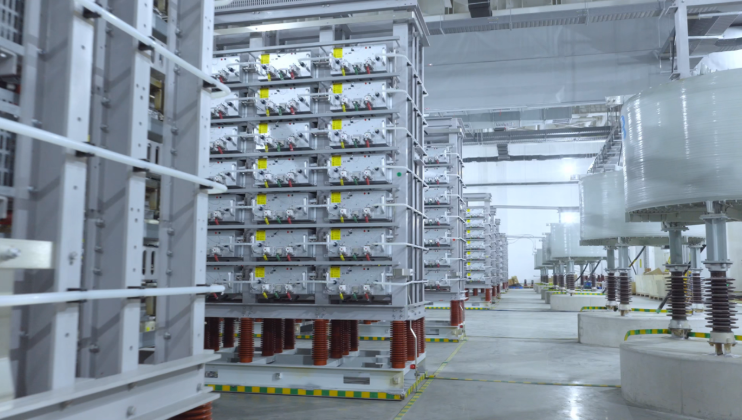
This development marks a structural turning point in the economics of global electrification, moving the industry’s strategic emphasis away from raw material extraction and directly into advanced manufacturing scale.
CATL to mass-produce sodium-ion batteries in 2026, targets 600 km range – Car News China
Technical game changer: Why Sodium Could win?
Three technical advantages explain why sodium-ion batteries are poised to challenge lithium’s reign.
Here is why.
Mitigation from Commodity Shock
Unlike lithium, which suffers from volatile price swings and is concentrated in a few regions, sodium utilizes highly abundant, inexpensive precursors like soda ash that can be purchased anywhere in the world. At the raw material level, the cost differential is staggering, helping automakers insulate their entry-level vehicles from sudden supply chain spikes.
Heavy Cold Performance Breakthrough
Traditional Lithium Iron Phosphate (LFP) packs lose considerable efficiency in extreme cold. Sodium-ion cells, by contrast, maintain up to 90% of their capacity at –40°C, solving a major consumer adoption barrier in cold-climate regions.
The 600 km Milestone
Early generations of sodium batteries were confined to micro-cars and e-bikes. CATL’s advanced, next-generation cell configurations (marketed under its Naxtra brand) are now targeting a single-charge cruising range of 600 km. This psychological milestone places sodium-ion in direct competition with entry-level LFP configurations.
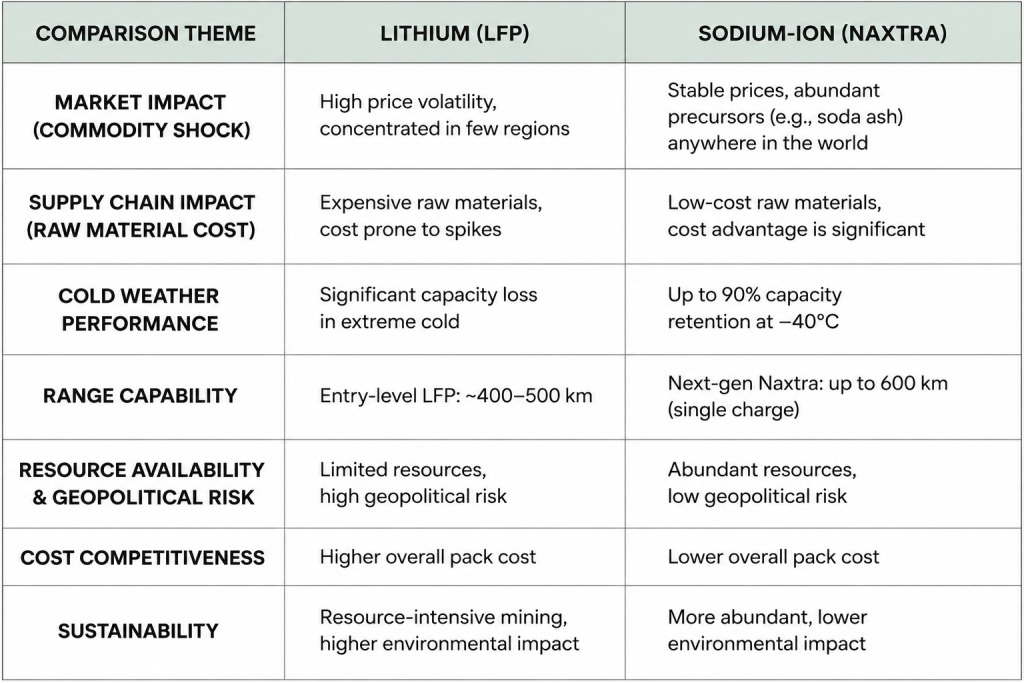
Sodium-ion combines affordability, supply resilience, and practical performance, positioning it as a promising next-generation battery solution.
Strategic Postures: Three Corporate Philosophies
The commercialization of sodium-ion has forced the world’s leading automotive and battery companies into completely different strategic camps.
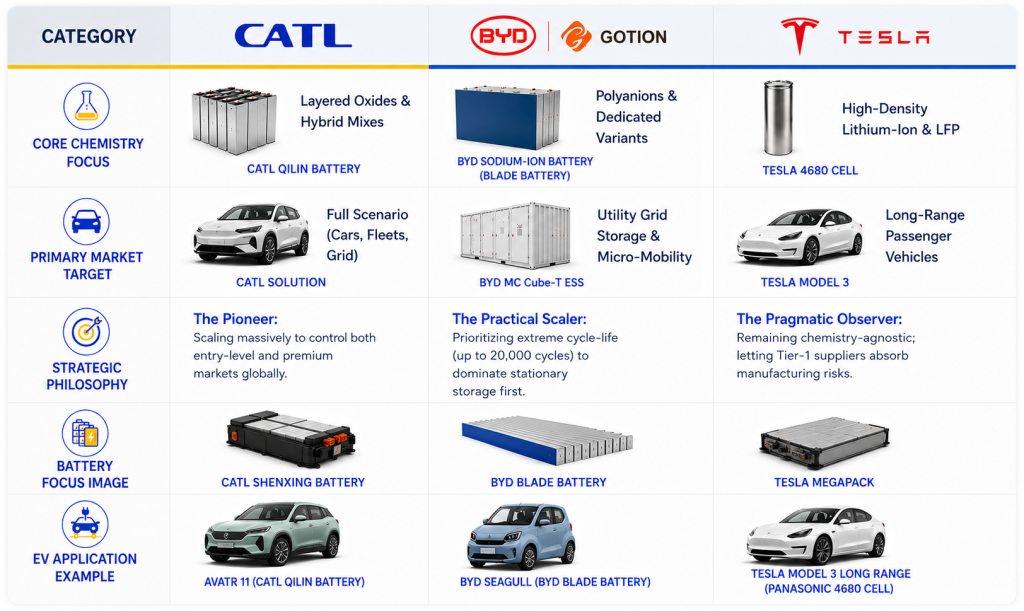
1. CATL: The Scale Dictator & Ecosystem Anchor
- The AB Battery Synergy: Instead of waiting for sodium to match lithium’s performance, CATL integrates both chemistries into a single, unified pack. This hybrid architecture uses lithium to maintain range and sodium to guarantee sub-zero performance, offering automakers an immediate commercial solution.
- Supply Chain Price Squeeze: CATL leverages its massive manufacturing footprint to aggressively drive down the dollar-per-kilowatt-hour cost of sodium precursors. By scaling faster than anyone else, they force competitors to either operate on razor-thin margins or remain trapped in niche markets.
Energy Storage Enters the 100-Gigawatt Era: Three Things to Know – BloombergNEF
2. BYD & Gotion High-Tech: The Specialized Competitors
- BYD’s Micro-EV and Grid Moat: BYD has vertically integrated its proprietary sodium cells directly into its massive micro-EV ecosystem (such as the Seagull series) and stationary energy storage lines, securing a defensive pricing moat at the absolute entry-level of the market.
- Gotion’s Highly Targeted Trifecta: Volkswagen-backed Gotion High-Tech bypasses general-purpose cells with its Gnascent platform, deploying an “anode-free” 261 Wh/kg cell for drones, a ultra-low temperature cell rated down to –50°C, and a grid-optimized cell engineered for 20,000 cycles.
Global EV Battery Usage Posted 1,187GWh, a 31.7% YoY Growth – SNE Research
3. Tesla: The Chemistry-Agnostic Observer
- Outsourcing Chemical CapEx Risk: Tesla intentionally stays out of direct sodium manufacturing, letting Chinese tier-1 suppliers absorb the volatile capital expenditure of scaling early-stage chemistry. This allows Tesla to focus its own resources on perfecting its proprietary structural 4680 lithium cells.
- Seamless Plug-and-Play Integration: Tesla positions itself purely as a high-volume buyer. The moment mass-produced vendor sodium packs achieve a significant cost-per-kilowatt-hour advantage over LFP, Tesla can seamlessly adopt them into standard-range vehicles and Megapacks without altering its own factory blueprints.
Tesla Investor Relations – Quarterly Evaluation and Corporate Disclosures – Tesla Investor Relations
Beyond the Material : Shift to Software and Structure
The surge of sodium-ion proves that the future of energy storage is no longer just a race for rare chemical compounds; it is shifting toward structural integration and software optimization. By utilizing advanced Battery Management Systems (BMS) and cell-to-pack (CTP) architectures, CATL can bypass material scarcity and extract maximum performance from abundant, low-cost elements.
Yet, for ultra-long-range, high-performance applications, the industry’s ultimate technological ceiling remains solid-state lithium systems. CATL is bridging these two worlds—sodium for the volume market, solid-state for the premium crown.
Conclusion: The New Intelligence Era of Energy Storage
Ultimately, the battle of the battery is shifting from a pure chemical race to an ecosystem race. As fast-evolving tech continues to break historical limits, the boundaries between consumer EVs and grid-scale storage are blurring entirely.
The rapid deployment of sodium-ion as a structural and software-driven solution proves that the ultimate capability of next-generation energy storage is no longer dictated solely by the chemistry inside the cell — but by a technological unprecedented mindset.